
12 Fascinating Facts About the Pink River Dolphin

Introduction
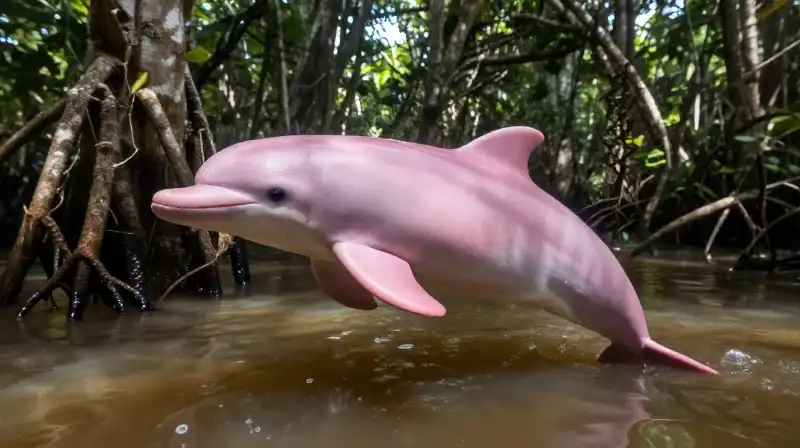
Deep within the murky, tea-colored waters of the Amazon and Orinoco river basins swims a creature that looks more like a character from a fairy tale than a typical marine mammal. The pink river dolphin, or boto (Inia geoffrensis), defies the standard image of a sleek, grey dolphin. Instead, it presents a striking silhouette: a bulbous forehead, a long, slender snout, and a complexion that can range from a subtle dusty rose to a brilliant, flamingo pink. While they share a name with their ocean-dwelling cousins, these freshwater specialists have evolved entirely different tools to survive one of the most complex river systems on Earth.
12 Fascinating Facts About the Pink River Dolphin

- They are freshwater specialists, not marine dolphins. Although they share the “dolphin” label, Inia geoffrensis is only distantly related to the dolphins found in the sea. They have spent their evolutionary history adapting to the specific demands of river life rather than the open ocean.
- Their pink color is a biological mystery. Scientists have several theories regarding why these dolphins turn pink. Some suggest the hue is a result of age, noting that males often appear pinker than females. Others believe the color might serve as camouflage against the reddish river mud, or that the pinkness is actually scar tissue from social fighting. Interestingly, some researchers believe their color may fluctuate based on water clarity or even “flush” a brighter pink when the animal becomes excited.
- They possess incredible neck flexibility. Unlike marine dolphins, which have fused neck vertebrae to help them swim fast in open water, the boto has unfused vertebrae. This allow them to turn their heads significantly—with some reports suggesting a 180-degree range of motion. This is a vital adaptation for navigating through the tangled, submerged roots of flooded forests.
- Their anatomy is built for the jungle. Instead of a traditional dorsal fin, the pink river dolphin has a modified hump on its back, which helps it maneuver through tight spaces among sunken trees.
- They are highly intelligent. The boto possesses a remarkable brain capacity, reported to be approximately 40% larger than that of humans. This high level of intelligence likely aids in their complex social behaviors and hunting strategies.
- They are expert hunters in low visibility. To find food in dark, muddy waters, they rely heavily on echolocation. Their specialized snouts are also equipped with bristle-like hairs, which act as sensory tools to help them feel for prey along the river bottom.
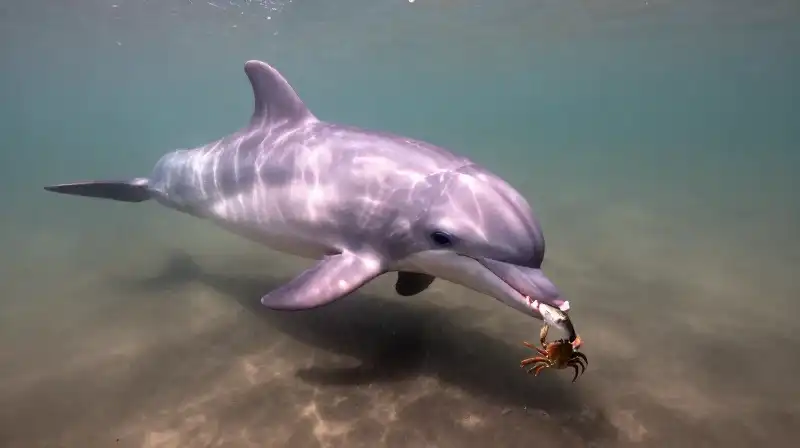
- They have a diverse diet. These dolphins are not picky eaters; they hunt over 50 different types of prey, including various fish, shrimp, crabs, and even small turtles.
- They are not blind. Despite living in turbid, opaque water and having relatively small eyes, they possess good eyesight and are known to be highly inquisitive creatures.
- Their size varies by report. Because they live in wild, varying environments, recorded measurements can differ. Some sources estimate an average length of 6.5 feet and a weight of 355 pounds, while others state they can reach up to 8 feet long and weigh as much as 450 pounds.
- They are the subjects of local legend. In South American folklore, the boto is often portrayed as a shapeshifter. Legend says they can transform into handsome men wearing hats—a detail used to hide their blowhole—to charm people.
- They are an endangered species. The pink river dolphin is currently listed as “endangered-threatened” by the IUCN.
- Human activity is their greatest threat. Their survival is challenged by several factors, including being caught accidentally in fishing nets (bycatch), being used as bait for catfish, habitat loss from dam construction, and mercury contamination resulting from gold mining.
Physical Profile: Boto vs. Marine Dolphins
To better understand the pink river dolphin’s unique adaptations, it is helpful to compare them to the dolphins most people are familiar with.
| Feature | Pink River Dolphin (Boto) | Typical Marine Dolphin |
|---|---|---|
| Habitat | Freshwater (Amazon/Orinoco rivers) | Saltwater (Oceans) |
| Neck Structure | Unfused vertebrae (highly flexible) | Fused vertebrae (stable for speed) |
| Dorsal Feature | Modified hump | Prominent dorsal fin |
| Snout | Long, skinny, with sensory bristles |
Common Questions About Pink River Dolphins
What do pink river dolphins eat?
They maintain a varied diet to thrive in the river ecosystem, consuming over 50 different species, including fish, shrimp, crabs, and small turtles.
Why are pink river dolphins endangered?
The decline of their population is driven by human-related factors. These include mercury pollution from mining, the construction of dams that fragment their habitat, and the danger of being caught in fishing gear or used as bait.
Are pink dolphins dangerous?
While they are highly intelligent and inquisitive, there is no scientific evidence to suggest they are a danger to humans. Most “danger” associated with them in local culture stems from folklore and myths rather than biological reality.
The Importance of Conservation
The pink river dolphin is more than just a striking visual anomaly in the Amazon; it is a highly specialized predator that plays a vital role in the health of freshwater ecosystems. Their unique anatomy—from their flexible necks to their sensory-rich snouts—represents millions of years of specialized evolution. However, as habitat fragmentation and pollution continue to rise, the survival of this intelligent, rose-hued species depends on our ability to protect the river systems they call home.
Facts sourced from peer-reviewed marine biology research, NOAA, and the Smithsonian Ocean Portal. Our editorial team fact-checks all content against current scientific literature.
Related Articles