
12 Fascinating Facts About Narwhals: The Unicorns of the Sea


Introduction
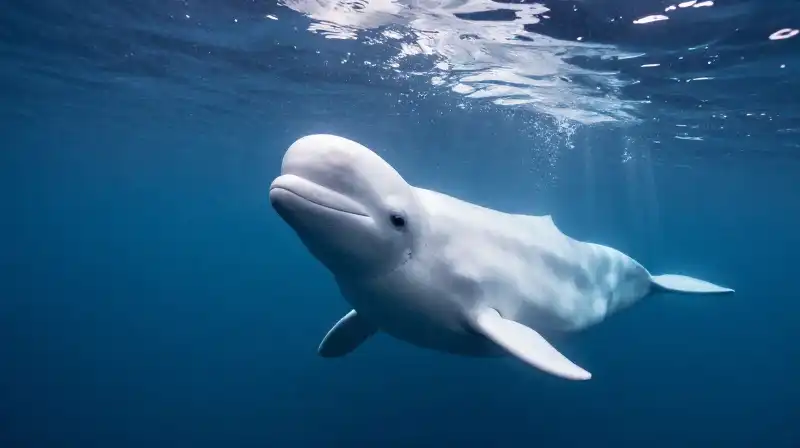
High in the Arctic waters, where the ice meets the deep, lives a whale that seems plucked from a storybook. The narwhal is often called the “unicorn of the sea,” a nickname earned by the striking, spiral projection that emerges from its head. While legends once suggested these creatures were mythical or even mere taxidermy oddities, they are very real, highly specialized cetaceans perfectly adapted to one of the harshest environments on Earth.
The Tusk: More Than Just a Horn
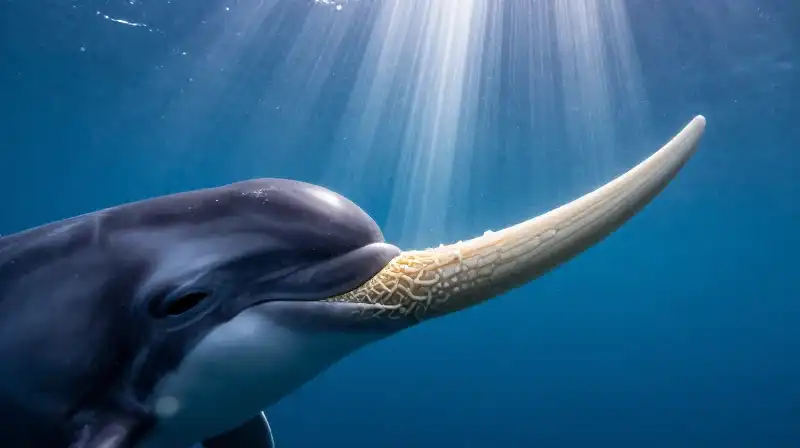
The most famous feature of the narwhal is frequently misunderstood. Despite its appearance, the “horn” is not actually a horn at all. According to it is an enlarged, spiraled ivory tooth that grows through the whale’s upper lip.
While the tusk is most commonly seen on males, it is not exclusive to them. Approximately 15% of females also develop a tusk, though it is typically shorter than the specimens found on males. These impressive structures can reach lengths of 9 to 10 feet and may weigh more than 22 pounds.
Biologists are still uncovering exactly how the narwhal uses this tool, but recent research suggests it is far from a decorative ornament. The tusk is incredibly sensitive, containing up to 10 million nerve endings. This sensory capability likely allows the whale to detect subtle changes in its environment, such as fluctuations in water temperature, pressure, or salinity.
12 Fascinating Facts About Narwhals
To understand why these animals are so unique, we have to look at their biology, their social lives, and how they navigate the deep. Here are some of the most interesting random facts about narwhals:
- They are master divers: Narwhals are capable of incredible deep-sea descents, reaching depths of approximately 1,500 meters (about one mile).
- Breath-holding experts: To support these deep dives, they can hold their breath for as long as 25 minutes.
- Suction feeders: Instead of biting or tearing, these carnivores often use a vacuum-like suction method to pull prey—such as Greenland halibut, polar cod, squid, and shrimp—directly into their mouths.
- Changing colors: A narwhal’s appearance evolves as it matures. They begin life as blue-gray newborns, transition to blue-black as juveniles, become mottled gray as adults, and eventually turn almost entirely white as they age.
- Social structures: Most narwhals live in social pods consisting of 10 to 100 individuals, though they can occasionally form massive “super pods” of hundreds or even thousands during the summer months.
- Diverse names: The name “narwhal” comes from the Norse word nar, meaning “corpse-like,” referring to their pale complexion. In contrast, the Inuit name, Oialugaq qernartaq, translates to “the one that points to the sky”.
- Historical luxury: In the 16th century, narwhal tusks were so highly prized by royalty that a single carved tusk could be worth the equivalent of a castle.
- Nutritional value: For the Inuit, narwhal skin is a vital dietary staple, providing as much vitamin C per ounce as oranges.
- Deep-sea diet: Their diet is specialized for the Arctic, focusing heavily on Greenland halibut and various types of cod and squid.
- Size variations: While often characterized by their tusks, their body size is also significant, with populations reaching up to 17 feet in length (Competitor Snippet).
- Weight: These whales can weigh up to 4,200 pounds, providing the necessary mass to thrive in cold Arctic waters (Competitor Snippet).
- Arctic specialists: Every aspect of their biology, from their fat layers to their sensory tusks, is fine-tuned for life in the ice-choked North.
Physical Characteristics at a Glance
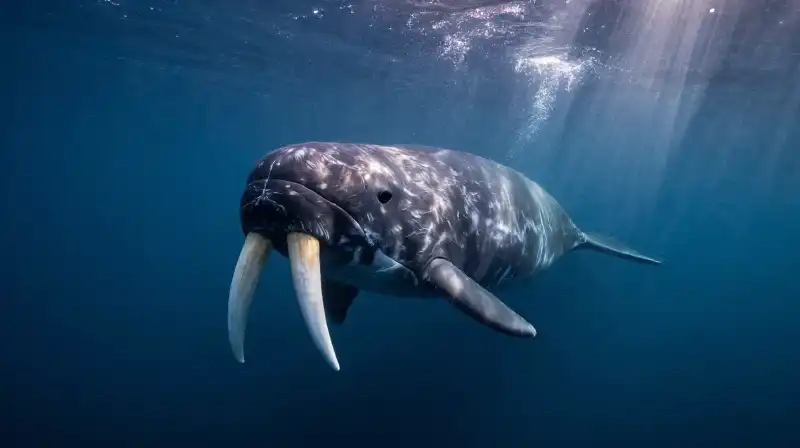
To better visualize the narwhal’s unique traits, the following table compares the tusk and the physical appearance across different life stages.
| Feature | Description/Detail |
|---|---|
| Tusk Composition | Enlarged, spiraled ivory tooth (not a horn) |
| Tusk Length | 9 to 10 feet |
| Tusk Sensitivity | Up to 10 million nerve endings |
| Newborn Color | Blue-gray |
| Adult Color | Mottled gray |
| Elder Color | Nearly all white |
Common Questions About Narwhals
Where do narwhals live?
Narwhals are found in the Arctic waters of the North Atlantic and Arctic Oceans. They are highly specialized for life among the sea ice.
Are narwhals endangered?
While the exact status can vary, their Arctic habitat is under significant pressure. They face threats from climate change, which affects sea ice levels, as well as oil and gas development and noise pollution from shipping vessels. This noise can be particularly harmful as it interferes with their ability to communicate.
A Fragile Future

The very things that make the narwhal remarkable—its ability to dive deep into the dark, its sensitive sensory tusk, and its specialized Arctic lifestyle—also make it vulnerable. As the Arctic warms and human activity like shipping and resource extraction increases, the narwhal’s quiet, icy world is changing. Protecting these “unicorns” requires understanding not just their biology, but the delicate balance of the entire Arctic ecosystem they call home.
Facts sourced from peer-reviewed marine biology research, NOAA, and the Smithsonian Ocean Portal. Our editorial team fact-checks all content against current scientific literature.
Related Articles